Container Home Ideas: Sizes, Layouts and What to Plan For

Short answer: no, you can’t buy a Tesla tiny house. The only “Tesla Tiny House” was a 2017 promotional unit that Tesla towed around Australia with a Model X to show off its solar panels and Powerwall battery. It was never for sale. The viral posts offering a Tesla house for $5,000 – $12,000 have been rated false by fact-checkers, and some lead to scams.
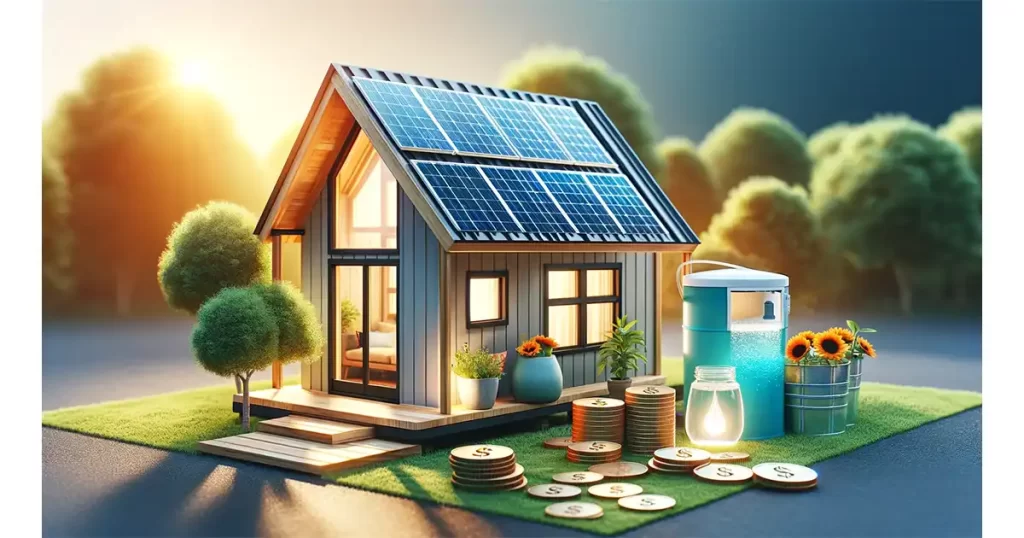
The good news: everything that made the Tesla Tiny House interesting (a small house on a trailer, rooftop solar and a home battery) is something you can build or buy today. Below are the real specs of the 2017 unit, how to spot fake listings, and what it takes to build a solar-powered tiny house of your own.
In August 2017, Tesla unveiled the “Tesla Tiny House” at Federation Square in Melbourne. According to Electrek, it was a mobile showroom: inside was a design studio and configurator where visitors could plan a solar-plus-battery system for their own home, with one-on-one sessions with Tesla staff. The house set out on a tour of major Australian cities, and towns could request a visit through Tesla’s website.
Tesla published these specs:
| Spec | Tesla Tiny House (2017) | In US units (our conversion) |
|---|---|---|
| Weight | 2 tonnes | About 4,400 lb |
| Dimensions | 6 m × 2.2 m × 4 m | About 19.7 ft × 7.2 ft × 13.1 ft |
| Solar | 2 kW system, 6 panels | — |
| Battery | 1 Tesla Powerwall | — |
| Exterior | Locally sourced, chemical-free timber cladding | — |
| Tow vehicle | Tesla Model X | — |
Source: Tesla’s specs as reported by Electrek, August 2017. Conversions are ours.
Australia made sense for the tour: Electrek noted that the country had the world’s highest per-capita rate of rooftop solar at the time. The tiny house was a marketing tool for Tesla’s energy products, not a housing product.
Since 2024, social media has been full of posts claiming that Elon Musk or Tesla is releasing a low-cost house, usually with a futuristic capsule-shaped image and a Tesla logo. Prices in these posts typically range from about $5,000 to $12,000.
PolitiFact investigated these claims in November 2024 and rated them False. It found no news releases or credible news reports about Tesla building affordable homes. Tesla’s website listed solar panels, Solar Roof and Powerwall, but no houses. PolitiFact also confirmed that the 2017 Tesla Tiny House was only a model to showcase solar technology, and that Tesla never sold it or any house like it.
If you see a listing like this, don’t pay or share personal details. Check the company’s official site and news coverage first.
You don’t need Tesla to build a tiny house that runs on solar power and a battery. Here’s how the pieces fit together.
Start with your daily energy use in kilowatt-hours (kWh). List each appliance, its wattage and how many hours a day you use it:
Daily kWh = Σ (watts × hours per day) ÷ 1,000
For comparison, the US Energy Information Administration reports that the average US residential customer bought 10,791 kWh of electricity in 2022, about 899 kWh a month. A tiny house typically uses much less, but electric heating, air conditioning, an electric water heater and induction cooking can push usage up quickly.
A solar array’s daily output depends on its size, your location’s sunlight (often expressed as “peak sun hours”) and system losses such as wiring, inverter efficiency, heat and shading. A simplified estimate:
Daily kWh ≈ array size (kW) × peak sun hours × (1 − losses)
Example (hypothetical numbers): the 2 kW array on the Tesla Tiny House, at a site with 5 peak sun hours and 15% losses, would produce about 2 × 5 × 0.85 = 8.5 kWh a day. Your real numbers will differ by location and season. NREL’s free PVWatts tool estimates production for a specific address.
The battery covers the night and cloudy days. Multiply your nightly use by the number of days of backup you want, and check the battery’s usable capacity and power rating on the manufacturer’s spec sheet. A Tesla Powerwall is one option, but there are many home and RV battery systems from other manufacturers.
Have a licensed electrician design or check the system, especially the battery installation. Local electrical codes and utility rules apply.
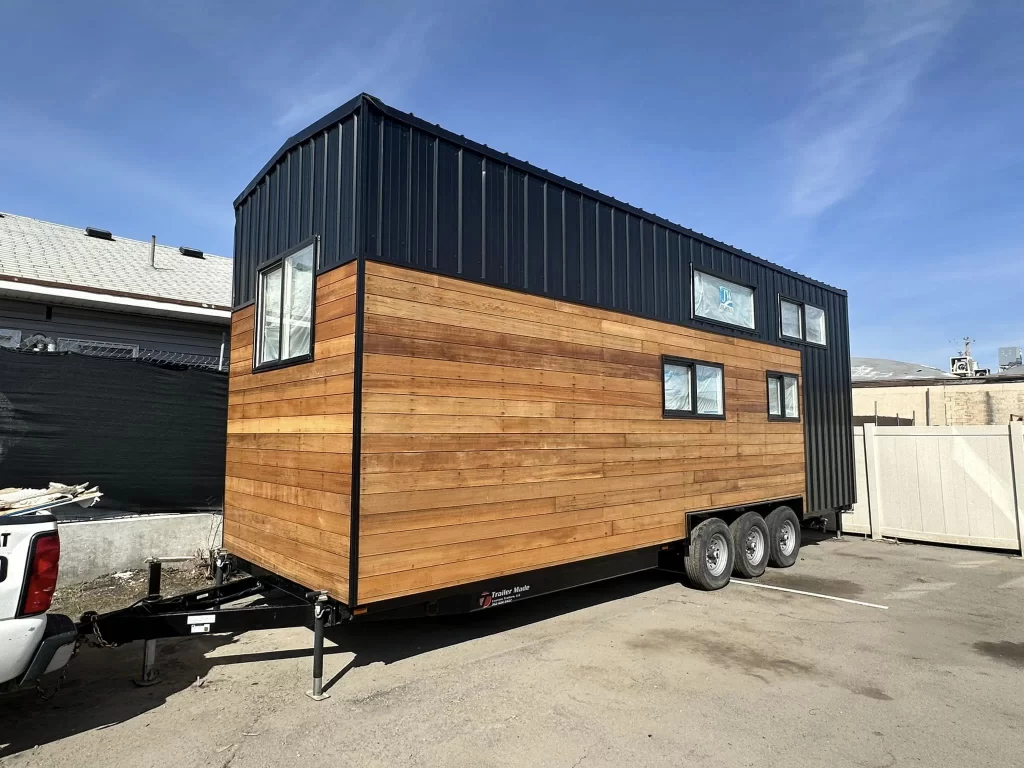
Tesla towed its 2-tonne tiny house with a Model X. If you want to do something similar with your own tiny house, the same rules apply as with any tow vehicle:
Most full-size tiny houses weigh much more than Tesla’s showroom unit. The Tiny Life puts the average tiny house at about 8,500 lb, which is well beyond the towing capacity of many passenger vehicles. Estimate your house’s loaded weight with our trailer weight calculator before choosing a tow vehicle.
Solar power is a great match for a tiny house, but it helps to set realistic expectations:
No. Tesla built one promotional tiny house in 2017 to show its solar panels and Powerwall in Australia. It was never sold, and fact-checkers have rated claims of a Tesla house for sale as false.
Tesla listed it at 2 tonnes, about 4,400 lb, with dimensions of 6 × 2.2 × 4 m.
A 2 kW solar system of six panels and one Tesla Powerwall battery.
No. PolitiFact found no evidence for claims that Musk or Tesla is releasing low-cost homes and rated them false. Be careful with listings that ask for deposits.
Trailerite is not affiliated with Tesla. Solar and towing figures here are simplified estimates for planning. Follow your vehicle’s and equipment manufacturers’ ratings, and have electrical systems designed or checked by a licensed electrician.