Container Home Ideas: Sizes, Layouts and What to Plan For

Quick facts: a 32 ft tiny house on wheels built on a standard-width trailer gives you about 272 sq ft of main floor (32 × 8.5 ft), plus one or two lofts. The bare trailer alone weighs around 4,100 lb, and a finished house this size often weighs well over 10,000 lb. That’s enough to need a heavy-duty truck, and in some cases a commercial license. At $150 – $450 per square foot, the main floor alone works out to roughly $41,000 – $122,000.
A 32-footer is one of the most popular sizes for full-time living: big enough for a real kitchen, a full bathroom and a downstairs bedroom or office, but still movable. Here’s what that size really means for space, weight, towing and cost.
Federal rules limit vehicle width to 102 inches (8.5 ft) on the National Network of highways, so most tiny houses on wheels are built to that width. Height and overall length limits are set by each state, so check yours before you finalize the design.
| Measurement | 32 ft tiny house | Notes |
|---|---|---|
| Length | 32 ft | Usually the deck length; the tongue adds a few feet |
| Width | 8.5 ft (102 in) | Federal maximum width (23 CFR 658.15) |
| Main floor area | About 272 sq ft | 32 × 8.5; interior area is smaller after walls |
| Lofts | Often 1 – 2 | Lofts add sleeping space but usually have low ceilings |
| Height | Set by your state | Limits the loft headroom |
Your real interior floor area is less than 272 sq ft once you subtract wall thickness. With 2×4 walls and siding, you typically lose several inches on each side, which adds up over 32 ft of length.
Here’s how a 32 ft house compares with other common trailer lengths. Floor area assumes 8.5 ft width; trailer weights are typical bare tiny house trailer weights published by The Tiny Life.
| Trailer length | Main floor (8.5 ft wide) | Typical bare trailer weight |
|---|---|---|
| 16 ft | 136 sq ft | 2,300 lb |
| 20 ft | 170 sq ft | 2,700 lb |
| 24 ft | 204 sq ft | 3,300 lb |
| 28 ft | 238 sq ft | 3,700 lb |
| 30 ft | 255 sq ft | 3,900 lb |
| 32 ft | 272 sq ft | 4,100 lb |
| 34 ft | 289 sq ft | 4,400 lb |
| 36 ft | 306 sq ft | 4,700 lb |
| 40 ft | 340 sq ft | 5,300 lb |
Going from 24 ft to 32 ft adds about 68 sq ft of floor, roughly the size of a small bedroom. That’s often the difference between sleeping only in a loft and having a ground-floor bedroom.
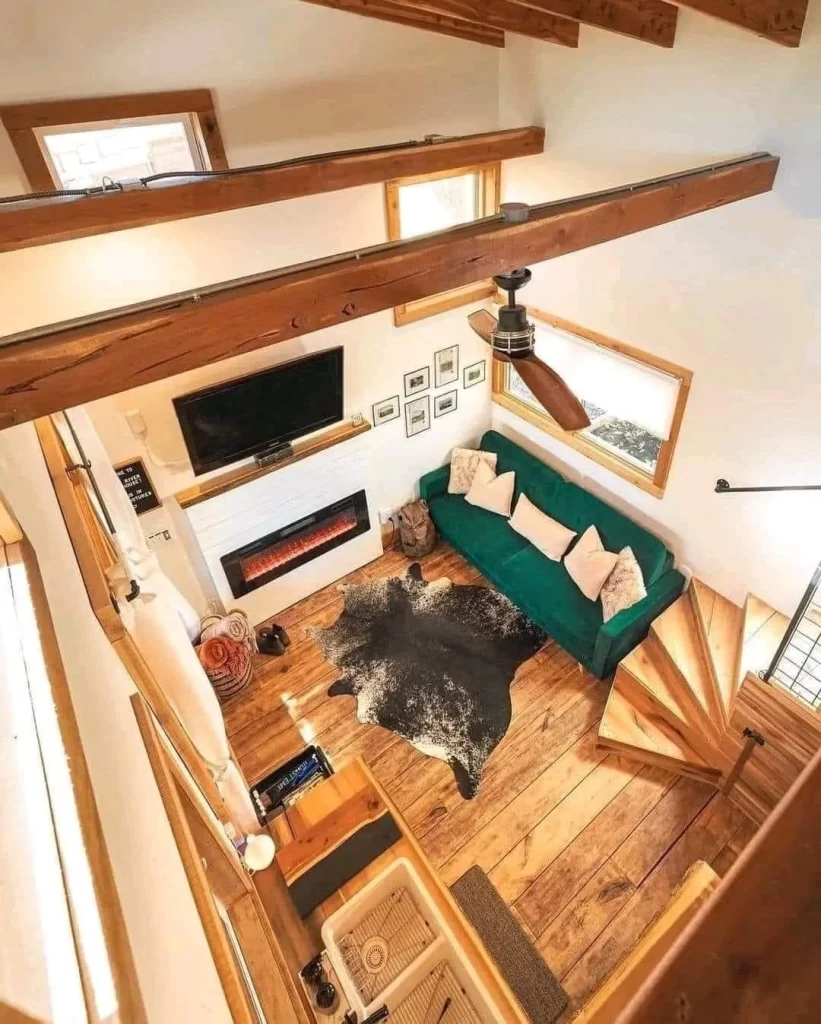
With 272 sq ft you can fit the rooms people miss most in smaller houses. Popular layouts include:
Lofts rarely have full standing height in a road-legal house, because the overall height limit leaves only a few feet above the loft floor. Plan them as sleeping and storage areas.
The Tiny Life puts the average tiny house at about 8,500 lb, and gives examples of finished houses weighing 10,500 lb (24 ft), 11,500 lb (26 ft), 13,500 lb (35 ft) and 14,000 lb (34 ft). A 32 ft house built with conventional framing, drywall or wood paneling and a full kitchen can easily land in the 10,000 – 14,000 lb range. That range is our estimate from those examples, not a rule: materials, appliances and finishes make a big difference.
Where the weight comes from:
The trailer’s GVWR must be higher than the finished, loaded weight of the house. Choose the trailer after you have a rough weight estimate, not before. You can add up your materials, water and cargo with our trailer weight calculator. Better still, weigh the finished house at a public truck scale.
A house this heavy is usually towed with a heavy-duty pickup (often a 3/4-ton or 1-ton truck) or moved by a professional hauler. Before you tow it yourself, check three numbers:
Under federal rules, a Class A commercial driver’s license is required to operate a commercial combination with a gross combination weight rating of 26,001 lb or more when the towed unit’s GVWR is over 10,000 lb (49 CFR 383.91). A heavy truck plus a 32 ft tiny house can reach those numbers. Whether this applies to you depends on whether the move is commercial and on your state’s licensing rules for private (non-commercial) drivers, which vary. Check with your state’s DMV before you tow, or hire a licensed hauler.
The Tiny Life puts tiny houses at roughly $150 – $450 per square foot. Applied to the 272 sq ft main floor of a 32 ft house:
| Cost level | Per sq ft | 32 ft house (272 sq ft) |
|---|---|---|
| Budget / DIY | $150 | About $40,800 |
| Mid-range | $300 | About $81,600 |
| High-end | $450 | About $122,400 |
These are our multiplications, using the main floor only; lofts and premium finishes push the total higher. For comparison, Clever Tiny Homes puts a professionally built tiny house on wheels at $70,000 – $150,000 in 2026, with most between $80,000 and $130,000. Bigger houses usually sit toward the upper end. For an item-by-item budget, see our tiny house cost breakdown, and if you’re deciding whether to DIY, read is it cheaper to buy or build a tiny house.
Don’t forget the costs that come on top of the house: land or a parking spot, utility hookups, permits and delivery.
Good fit if: you’ll live in it full time, want a ground-floor bedroom or real kitchen, are a couple or small family, or rarely plan to move it.
Consider smaller if: you plan to travel often, want to tow with a lighter truck, or are parking in tight spaces like backyards with narrow access.
Consider a foundation if: you’ll never move it. A house on a permanent foundation can be larger and isn’t limited by road width and height, although it has to meet local building codes.
About 272 sq ft of main floor on an 8.5 ft wide trailer (32 × 8.5), before subtracting wall thickness. Lofts add more space, but usually with low ceilings.
The Tiny Life lists about 4,100 lb for a bare 32 ft tiny house trailer. Always check the actual weight and GVWR from the trailer maker.
Usually a heavy-duty pickup with a towing capacity, GCWR and payload high enough for the house’s loaded weight and tongue weight. Weigh the house, then compare the numbers with your truck’s ratings, or hire a professional hauler.
It can be, if it stays within the federal 8.5 ft width limit and your state’s height, length and weight limits. Wider or taller loads usually need oversize permits.
Weights and costs are estimates for planning. Size, height, weight and licensing rules vary by state. Always follow your trailer’s GVWR, your vehicle’s ratings and your state’s laws, and weigh the finished house before towing.